

Master Program Governance and Leadership

About this study program
A two-year multi-disciplinary (part-time) master program for bachelor graduates in society-oriented disciplines and for public and private sector professionals.
Subject
In the Dutch Caribbean, as in every society, there is increasing pressure on organizations with a public task and responsibility to perform effectively and efficiently and to be responsive as well as accountable to citizens. The grand challenges of today, like the achievement of the sustainable development goals (SDGs) or the fight against pandemics, underpin the need for knowledgeable, skilled, and innovative government administrators, policymakers, and managers. They must deal with new and uncertain situations, challenges, and crises for which no routines exist. This calls for new forms of cooperation between government organizations, between government and the private sector, civil society organizations, and citizens. Competent, good governance and leadership are core to maintaining and enhancing the quality of an inclusive and sustainable society.
In Aruba and the other islands of the Dutch Caribbean, there is a broadly articulated and urgent need for capacity building on an advanced university level in the domains and intersections of governance, leadership, organization, management, and business administration; all in the context of a small island developing state.
Focus
Central in this program is the insight that each situation calls for a creative contextual response, not for ready-made solutions. We bring you state-of-the-art knowledge and insights in fields like public and private governance, effective policy making, public value, leadership, and management. With this, you will be able to analyze and reflect on what is happening in society, and in its organizations and services. Secondly, you will be able to analyze and reflect on your own – potential – role and performance in organizations and in dealing with societal challenges. You will be stimulated to reflect on future developments, on shaping the future, and on (designing) innovative governance practices. This master program is connected with concrete practices and focuses on the further development of your professional repertoire. Theoretical knowledge, the development of analytical and professional skills as well as the practical experience of yourself and the lecturers, are the ingredients that make this master’s program directly valuable for both your own professional development and the quality of governance and leadership in the Dutch Caribbean.
Participants
This master program is developed both for graduates of relevant bachelor programs who want to continue their university education at a master’s level, and for professionals who already work in governance and management positions with leadership responsibilities. Our aim is to have participants from Aruba as well as the other parts of the Dutch Caribbean. With this program, we want to reach groups such as:
- Recently graduated alumni from the University of Aruba (UA) and graduates from other universities with a relevant bachelor university degree (e.g., Organization, Governance and Management, Social Work & Development, Public Administration and Public Policy, Political Science, Law, Economics or Business Administration, when combined with Public Finance Management and Political Economy);
- Alumni from the UA and other graduates with a university bachelor degree not related to the governance domain but who work in the field of (public or private) governance;
- Executive professionals with 5 to 10 or more years of experience and with an academic level of thinking and working in positions related to public sector management, public or private governance, and/or leadership.
Aim, learning outcomes and working methods
With this program, we aim to enhance your knowledge and insight on an academic master level as well as your ability to analyze, reflect and apply. You will be challenged to test your ideas and opinions against the knowledge and practical experience of others.
After successfully finishing this master program you have:
Knowledge of…
- State of the art scientific insights in governance studies and leadership studies;
- How specific characteristics of small island development states influence governance and leadership;
- Conditions for sustainable (economic and social) development, including respect for fundamental rights;
- Research and data analysis methods as well as strategies for evidence-informed policymaking in the public and private sector.
Skills to…
- Assess from different perspectives tensions public and private organizations have to cope with in relation developments in society and public administration;
- Develop a future-oriented perspective on conceivable and sustainable strategies and leadership for realizing the aims of public and private organizations;
- Design, execute and report independently on your own scientific research.
Attitudes for…
- Being self-reflective on one own leadership style and interpersonal skills;
- Appreciating diversity in cultural and political perceptions, opinions, and constructive dialogues;
- Appreciating ethical review and integrity in governance and leadership.
In each course, we combine a variety of working methods to stimulate an active and interactive learning experience in which knowledge sharing by teachers and students, discussions, case analysis, the application of knowledge in concrete cases, and skills training are equally important.
For this master program, the contact hours per course will be concentrated in a few high intensive course days in a row; in hybrid sessions (on location with online participation), as well as online seminars and through individual consultation and different forms of collaborative learning (on location and online).
Program
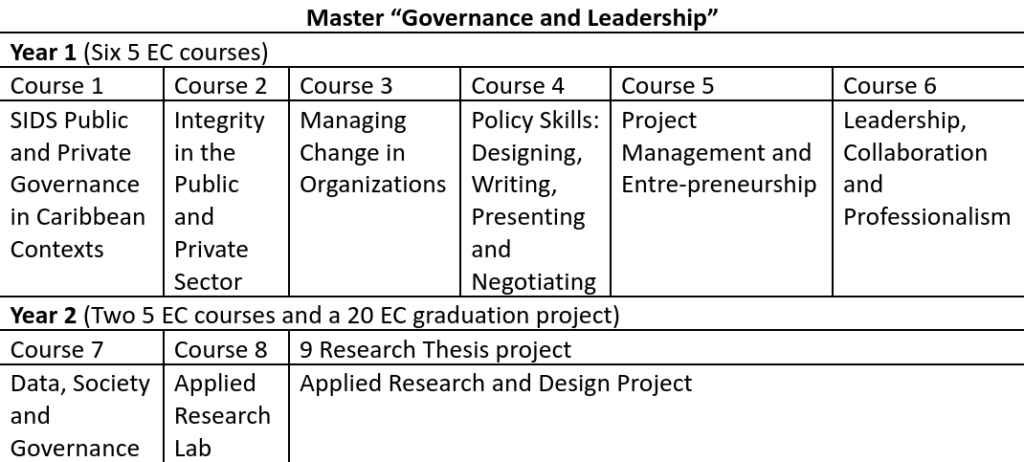
The 60 EC study program of the Master Governance and Leadership has a duration of two years (part-time) and consists of eight courses and a final thesis project; six courses in the first year and two courses and the thesis project in the second year. The course hours will be concentrated in three full or six half-day course days per course and will be organized in a blended form: partly fully online, partly on location at site of the University of Aruba with the option of online participation and a two- or three-concentrated course days on location for all participants at the beginning, middle and the end of the program.
During the first year, students get acquainted with the core themes of this master program, such as characteristics of Caribbean Governance, Change in Organizations, Accountability, and Collaborative Leadership. In the second year, we focus on analyzing and research societal issues in relation to governance and on designing meaningful solutions for these issues including operational strategies to implement these solutions. In both years, we connect and incorporate real-life issues, also coming from students and from their (future) professional environments.
Program per course
1. SIDS Public and Private Governance in Caribbean Contexts
Topical developments for Small Island Developing States (SIDS) and their meaning for public and private governance and leadership in the Caribbean will be the focus here. Issues of governance will be juxtaposed to diverse topics among others: Institutional Development, Democracies of Scale, Governance and leadership, Strategic Flexibility, New Caribbean Complexities, Economic Vulnerability, and Climate change.
2. Integrity in the public and private sector
In this course, students will reflect and gain insight on issues of integrity, public accountability, oversight, and transparency. Furthermore, students will strengthen their skills to identify risks and make creative and innovative choices to safeguard integrity and accountability in the public and private sectors.
3. Managing change in organizations
The course Managing change is designed to equip students to develop themselves into critical, reflective, and capable scholars, leaders and managers, who can facilitate change processes and transformation, as well as act as change agents in their organizations.
4. Policy skills: designing, writing, presenting, and negotiating
In this course, we will look at effective professional performance in different phases and stages of public sector policy making and implementation. Special attention is given to the qualities and the role of policy documents (white papers, memos, consultancy reports) in specific political-administrative contexts.
5. Project management and entrepreneurship
The focus in this course is on strategies and operational skills on how to design and manage projects in the context of small developing island states. Special attention will be placed on how to combine this with an entrepreneurial attitude.
6. Leadership, collaboration, and professionalism
How do you as a leader create public value in our volatile, uncertain, complex, and ambiguous society? In this module, students will learn how to facilitate collaborative processes and strategies within and across organizations that pursue the same public value by applying collaborative techniques and tools. During this course, students also reflect on their personal leadership qualities.
7. Data, Society and Governance
In this course, students will learn theories to understand how the complex societies we are part of, are ‘networked’. Data science, and the understanding of social life as complex data assemblages of both human and non-human actors as well as the intended and unintended consequences of data from a governance perspective, will be the focus here. The course will delve into themes such as connectivity, virality, networked interventions and policy tools, algorithms, e-governance, privacy, and ethics of data- and platform societies.
8. Applied Research Lab
In this course, students will learn the fundamentals of academic research methodology. Concretely, students will learn how to conduct hands-on research apt for the governance and organizational field. Students will acquire important theoretical foundations of research methodology and will practice with research tools and instruments in preparation for their individual research thesis projects.
9. Research Thesis Project
All the knowledge and skills acquired during the program will be applied to the culminating individual research thesis project. Students will take a current governance issue particularly related to the local context as their object of study and offer advice on this issue by conducting research, and or designing a policy plan or intervention in a real-life setting.
Organization
Location:
Premises of the University of Aruba and online.
Costs:
AWG. 4.000 per year (Excluding AWG. 500 admin fee) and 9,000 AWG for the two-year part-time program)
Language
In Aruba and in the Dutch Caribbean in general, we live in a multilingual society. In this master program, we both respect and appreciate that. English is the most prominent language for international cooperation and in the domain of governance and leadership. For that reason, it is an English-taught program with ample space for the official languages Papiamento and Dutch. Part of the assignments, written work, group work, discussions, and tutoring can be either in English, Dutch, and/or Papiamento. The decisive criterion here is that all students and lecturers involved have to be able to participate.
The language requirement for the master program Governance and Leadership includes a Test of English as a Foreign Language (TOEFL) transcript English with a minimum score of 79for the iBT or an equivalent exam.
Exempted from the TOEFL are applicants who obtained a Bachelor’s degree and/or Master’s whereby the language of instruction was English.
Application and selection:
An intake interview, combined with an assessment of previous education and/or professional experience, will be part of the application procedure. To optimize the conditions for successfully finishing the master program, candidates can be advised or required to follow a pre-master program or parts of a pre-master program before starting with the actual master program Governance and Leadership.
In the selection procedure, we focus on the match between the program and the required knowledge and experience. We look at:
• Previous education
• Language requirement in English
• Professional work experience from present or previous positions
• The ability to analyze and reflect on changes occurring in society in relation to the needs and the functioning of organizations
• A reflective attitude towards one’s own performance
• The ability to connect concrete cases and experiences to theoretical concepts.
Planning
- 2 year half time program nominal.
- Maximum 4 year time of completion.
- In case the integrated pre-master has to be followed, the maximum time of completion is 5 years.
- In case courses included in the pre-master are not considered to be a direct pre-requisite for master modules, they can be followed simultaneously with the master modules.
Pre-master program
The University of Aruba offers a pre-master program Governance and Leadership of 30 ECTS. This pre-master program consists of four 7,5 EC courses on an advanced bachelor level that helps prospective master students to be optimally prepared for the start of the program:
1) The sociology of SIDS
2) Research Perspectives in Governance Studies
3) Philosophy of Science
4) Communication and Organization
Costs
1.500 AWG per 7,5 EC pre-master course, 4.500 AWG for the pre-master program.
Separate courses options for executives
Executive professionals working in positions related to public sector management and public or private governance who do not need or do not strive (yet) to complete the full degree program, can still opt to follow one or more of the courses offered within the program. That can, for instance, happen when these courses match your professional needs or your wish for continuing your personal development.
For these executive professionals, we offer the eight 5 EC courses of the master program Governance and Leadership individually as a form of university continuing education or lifelong learning. The number of available places for these external students is dependent on the number of degree students.
To participate in a separate course, you can apply for that course. After an intake and given there are places available, you can register and pay a fee for that specific course. After completing the course, you will receive a certificate of attendance, a certificate of participation, or a certificate of successfully passing the course. These separate course completion certificates can at a later stage, but within 4 years after starting the first course, be used for applying for the master degree.
Costs
1.500 AWG per 5 EC course.
Course materials
Books
Prescribed textbooks for each unit of study are listed in your Study Guide, Book List, or on the UA Bookstore webpage.
You can purchase your textbooks in a number of ways:
The UA Bookstore at the University of Aruba
The UA Bookstore offers an inventory of textbooks for all faculties. The UA Bookstore also sells new study books and facilitates the sale of second-hand study books by students. If your books haven’t arrived on time you can also borrow certain study books from the UA Library. The University of Aruba’s bookstore is located in the UA Library.
The UA Bookstore online
Course readings and textbooks can be ordered online and collected later at the UA Bookstore.
Order your books now!Via external sources
You can also purchase your study books from other sources, such as second-hand books or online bookstores from the US or the Netherlands. Please take into account that books purchased online can take a couple of weeks to arrive. Buy your textbooks and readers early to make sure you have all your required reading material at the start of the school year.
The total cost of books for the complete Bachelor’s degree program is approximately AWG. 3.000,-
Other course materials
All study materials compiled by the lecturers will be made available via the electronic learning environment StOnE. Every registered student is also provided with an email address of the UA which is used to communicate with you. The curriculum of OGM includes the production of written papers. It is advisable to purchase a laptop or tablet for this study program.
Digital Tools
Study program digital resources
Important information about this study program can be found in the Study Guide. The Study Guide provides helpful details about the University, the study program, and essential information for every stage of the student journey, from registration, to assessment, to graduation.
You can also consult the Year Calendar, Course Schedules, Book List, and other essential documents relating to the program of study for more detailed information.
Go to the study program digital resourcesLibrary Databases
The UA library may be of assistance in providing you access to digital databases to quickly find relevant scholarly information you can use in research papers or other course projects. The databases available via the UA Library grant you access to countless journals, articles, and digital books.
StOnE
The Faculty of Arts & Science has an electronic learning environment, the University of Aruba Study Online Environment (StOnE). You can access StOnE via stone.ua.aw with your username and password. This information is made available after your final registration. For any questions, you can contact the helpdesk via StOnE@ua.aw
With StOnE you can:
- Easily access course content – browse the content of your courses, even when offline.
- Connect with course participants – quickly find and contact other people in your courses.
- Keep up to date – receive instant notifications of messages and other events, such as assignment submissions.
- Submit assignments – Upload images, audio, videos and other files from your mobile device.
- Track your progress – View your grades, check completion progress in courses and browse your learning plans.
Course material and assignments are made available by the lecturer of the course via StOnE. Other important announcements are also sent via StOnE or distributed via your UA email address. To ensure that you are sufficiently informed of the ins and outs of the study program you are expected to consult StOnE and your email address regularly to stay informed of any notifications.
OSIRIS
OSIRIS is a Student Progress Tracking System, in which all information regarding your studies and study progress is stored from the moment of your first registration up to and including your graduation. All UA students have an OSIRIS account as soon as they are fully enrolled and are admitted to the UA.
We recommend downloading the OSIRIS app on your phone so that you can stay up to date with your grades, your schedule and can have easy access to registration for courses and exams. Students must register to take courses via OSIRIS. Consult the course schedule to see when each course is given. This registration is mandatory!
You can log in here or via the OSIRIS Mobile App (available via the Google Play Store or Apple Store). For more information regarding your grades, course schedules, missing information, or other education-related issues to be found in OSIRIS, please contact the Office of Educational Affairs (OEA), in charge of the educational administration of students, at oea@ua.aw.
To gain access to OSIRIS you need a username and password. This information will be made known to you at the start of your studies. Your username for OSIRIS is your student number, your password is your UA network password (the same password you use in the Computer Lab or Library). If you encounter problems logging in, you may have to reset your password. During office hours you can do this at the reception of the main campus at UA.
For further assistance regarding technical problems you can contact the Computer Center at cc@ua.aw or by telephone at (297) 526-2252, or (297) 526-2253.
G Suite
G Suite is a set of cloud computing, productivity, and collaboration tools, software, and products developed by Google. Every registered student will obtain access to their own G Suite account and can make use of its email (Gmail), cloud storage (Google Drive with a capacity of 30GB), and other tools, such as Google Docs. This eliminates the need to use external storage devices such as USB sticks during your studies, minimizing the risks of viruses and losing your data. G Suite also allows you to access your information from any computer, eliminating the need to sync your data on different computers. The data on G Suite is available from your smartphone, tablet, laptop, or computer.
Your student email will be attached to your G Suite account. Important announcements are distributed via your student email. You are expected to consult your email regularly to stay up to date with student affairs and notifications.
For any questions relating to your G Suite account, you can contact the Computer Center at cc@ua.aw or by telephone at (297) 526-2252 or (297) 526-2253.
Practical information
For more practical information about student life at UA, the facilities the university offers, and information about your registration or changes in your personal information, please contact the Office of Student Affairs. You can also browse our website, or consult your Study Guide.
View our Frequently Asked QuestionsCollaborate with the UA
The University of Aruba can offer organizations interns, training, and research possibilities. If your organization would like to collaborate with the UA, please click on the button to fill in the form.
Fill in the formAlumni Network
Dear recent OGM graduate. Completing your Bachelor of Arts degree is not a small feat, and the OGM department wishes you lots of success in your following career and life. The OGM department would also like to stay in touch with our alumni, this is a great way for us to keep the OGM alumni network active.
Register Here